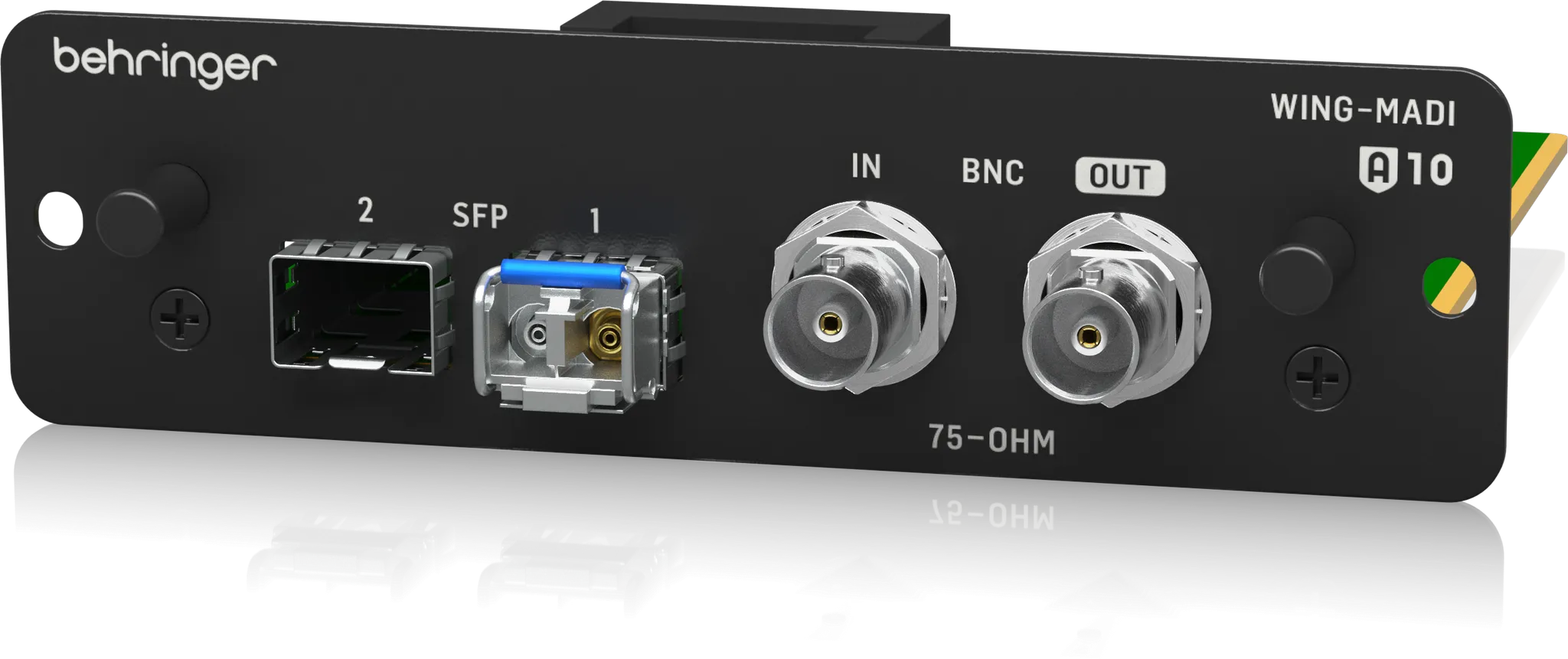
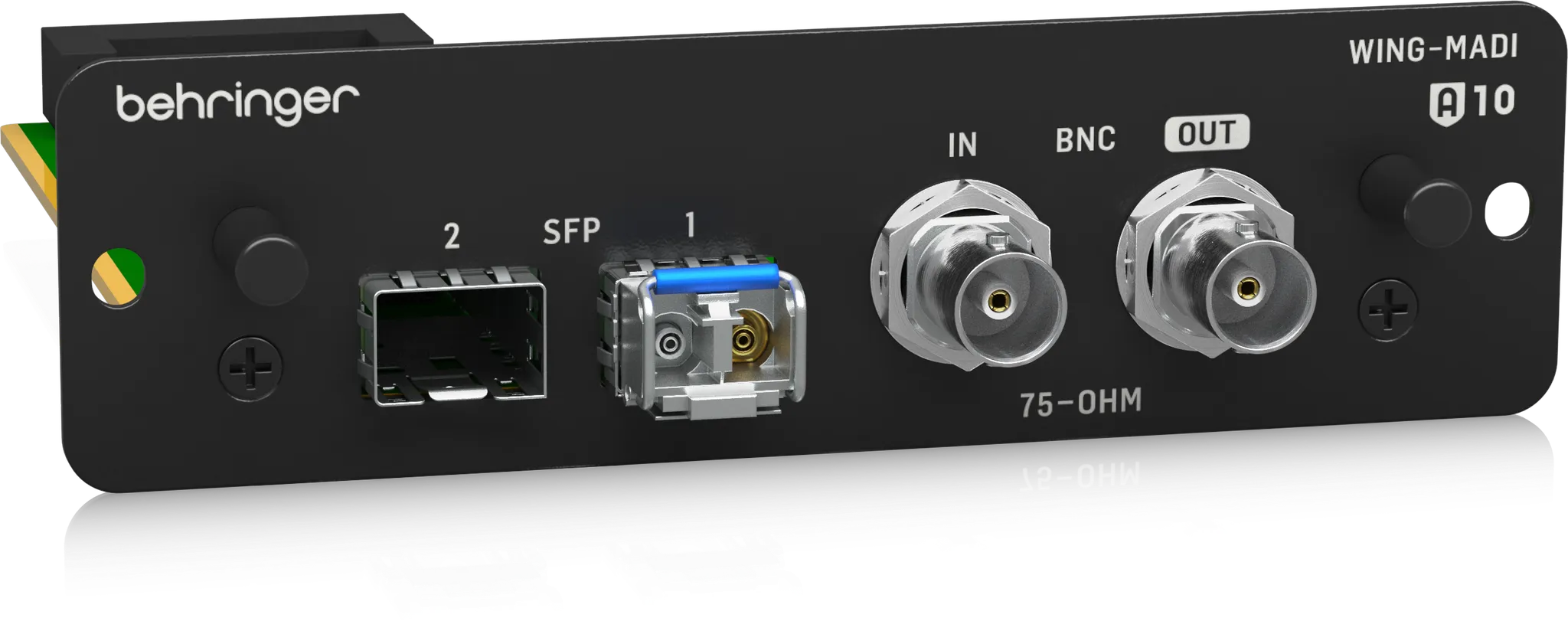
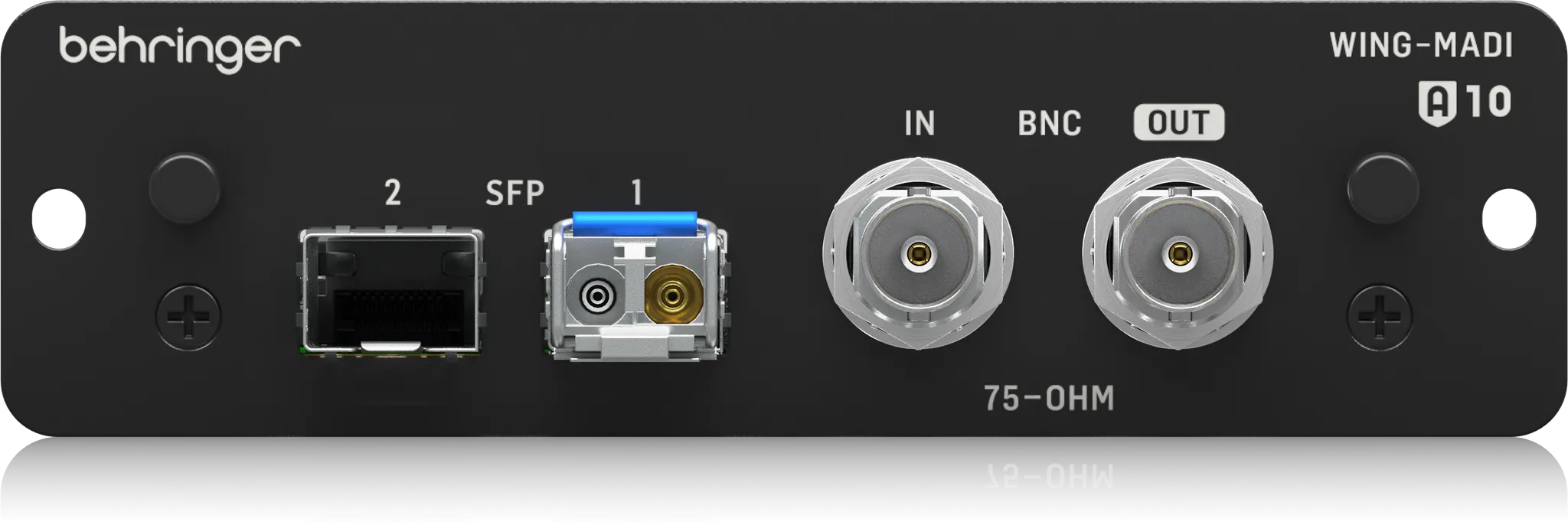
WING-Erweiterungskarte für 64x64-Kanal MADI über SC-Glasfaser oder BNC-Koaxialverbindungen
Multichannel Audio Digital Interface, the AES10 Standard
The mature, stable and widely interoperable standard has been published by the Audio Engineering Society back in 1991. And even after 35 years, its 64-channel capacity, low deterministic latency and reliability make it a valid choice in professional broadcast and high-end live production. It is securely connecting consoles, stage boxes, recorders, broadcast equipment and format converters.
Your Daily Dose of Fiber
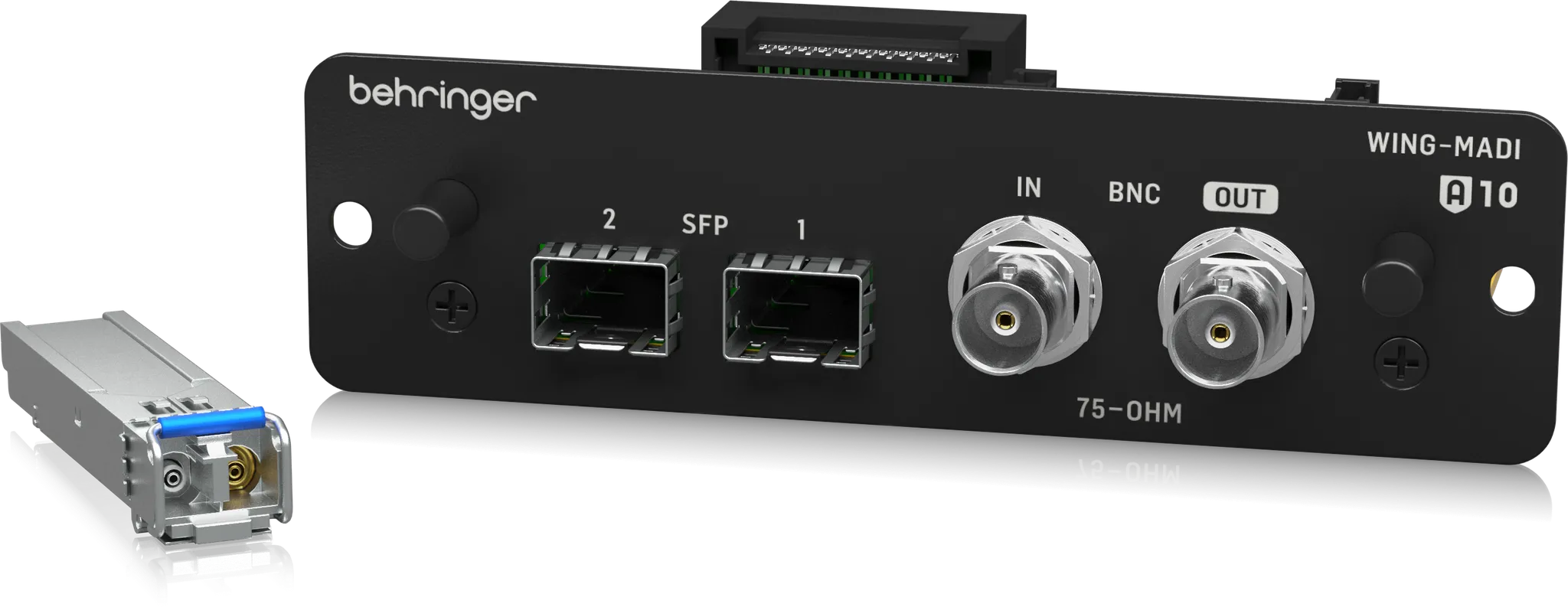
Every facility's fiber plant is different. That's why the WING MADI card uses SFP slots instead of fixed optical connectors. Single-mode or multi-mode, short haul or long, whatever connector standard your plant was built to — choose the transceiver that matches what you already have and slot it in. No media converters. No re-pulling fiber. Change facilities or change standards, and you change a module, not a card. A 1310 nm MADI-wavelength SFP with duplex LC connector is included, so it's ready to run out of the box and connect with any MADI equipment you already have.
64 Channels. Redundancy Included.
High channel count is a given with MADI. What matters is how much of it stays protected. At 48 kHz, the WING MADI card carries 64 channels of 24-bit audio with full redundancy across either 2 separate DLC connections on SFP1 and SFP2, or across separate connections on SFP1 and coaxial BNC.
Two Paths, Your Topology
Two SFP cages plus coaxial give you a choice of redundant pairs. Run both SFP slots optical for a fiber-to-fiber backup, or populate SFP1 and use the BNC coaxial side as the second path. If the primary link fails, the backup carries the stream — no interruption, no re-patching mid-program. For maximum security, make sure the 2 connections are run separately on different ways from A to B.
Distance Covered
Up to 2 km over 62.5/125 µm multimode fiber with the included module. Up to 100 m of 75-Ohm coax over BNC. Fiber for the long runs and the galvanic isolation that comes with it. Coax for the short, direct connections. And where your runs demand covering even more than 2 km, a single-mode SFP module changes the reach without changing the card.
For Broadcast
Broadcast facilities standardize their fiber plant, then expect gear to fit into it. This card does. Choose the SFP that matches your existing single-mode or multi-mode runs and integrate WING into any plant exactly as it stands — no adapters bolted onto a carefully specified infrastructure.
For Houses of Worship
Worship campuses grow one building at a time, and the fiber usually reflects that — different contractors, different eras, different cable in each run. In many cases it may still be a pair of coaxial copper lines with BNC connectors. SFP slots, on the other hand, let you match each link to whatever is actually in the wall, so expanding to the overflow room or the building across the lot doesn't start with a cable pull.